Modern Offshore Moorings: Dynamic Tensioning and Fatigue Analysis in Deepwater Environments
An in-depth technical analysis of catenary versus taut-leg mooring systems, cyclic wave-structure fatigue modeling, and tension monitoring protocols for floating facilities on the Vietnamese continental shelf.
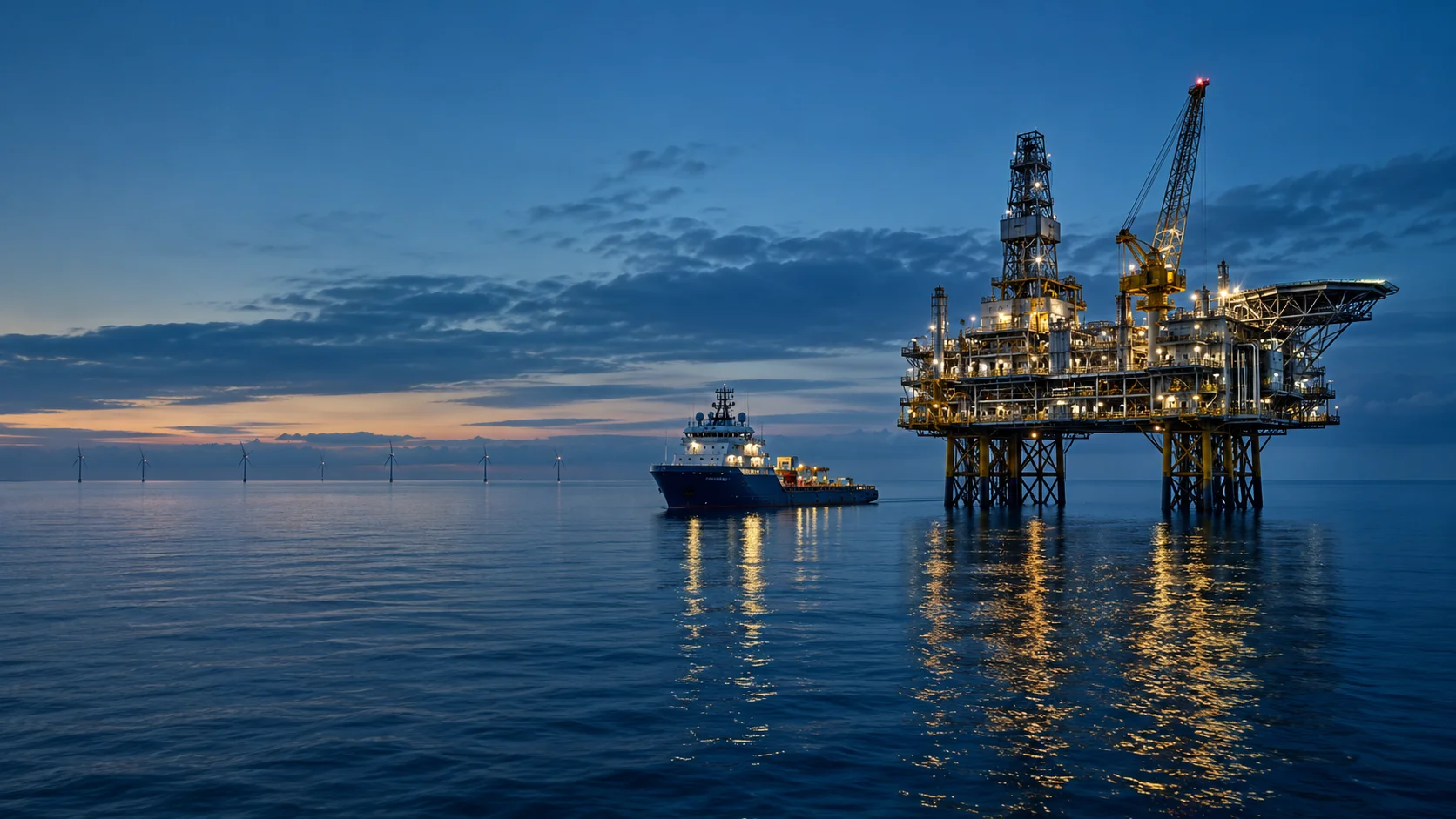
Illustrative visual representing engineering methodology at Thien An Offshore.
Executive Summary: Dynamic Tensioning & Fatigue Integrity
Evaluating dynamic tension variations, cyclic loading limits, and mooring line integrity for semi-submersibles and FPSO units operating under extreme monsoonal conditions in the South China Sea.
Deepwater Mooring Challenges for Floating Drilling Units and FPSOs
As exploration and production move beyond the 200-meter isobath into deeper waters of the Vietnamese continental shelf, floating structures encounter severe hydrodynamic loading caused by seasonal monsoons, deep currents, and internal solitons. Station-keeping integrity is the single most critical factor preventing subsea riser ruptures and collision risks in offshore energy production.
Traditional catenary mooring arrays depend heavily on the submerged self-weight of massive studless chain links resting on the seabed. While effective in shallow to intermediate depths, extending catenary systems into water depths greater than 300 meters imposes immense vertical weight penalties on the platform deck, drastically reducing allowable topside payload.
Hydrodynamic Damping and Offset Control
To mitigate deck payload penalties, modern deepwater installations increasingly deploy taut-leg or semi-taut synthetic fiber moorings utilizing high-modulus polyester or aramid lines. By tensioning lines at angles between 30 and 45 degrees, vertical excursion is minimized while horizontal restoring forces are provided through line elasticity rather than suspended chain weight.
Dynamic Fatigue and Cyclic Load Analysis in Mooring Lines
Mooring lines are subjected to millions of cyclic stress variations over a typical 20-to-25-year field lifecycle. Out-of-plane bending (OPB) at fairlead chain links and tension-tension fatigue along synthetic rope segments represent the primary degradation mechanisms requiring continuous engineering oversight.
Coupled non-linear time-domain simulation is mandatory for evaluating higher-order wave drift forces and vortex-induced motions (VIM). Accurate S-N fatigue curve formulation, combined with real-time acoustic load cells installed at fairlead shackles, enables offshore operators to predict tension peaks before cumulative damage indices exceed permissible safety thresholds.
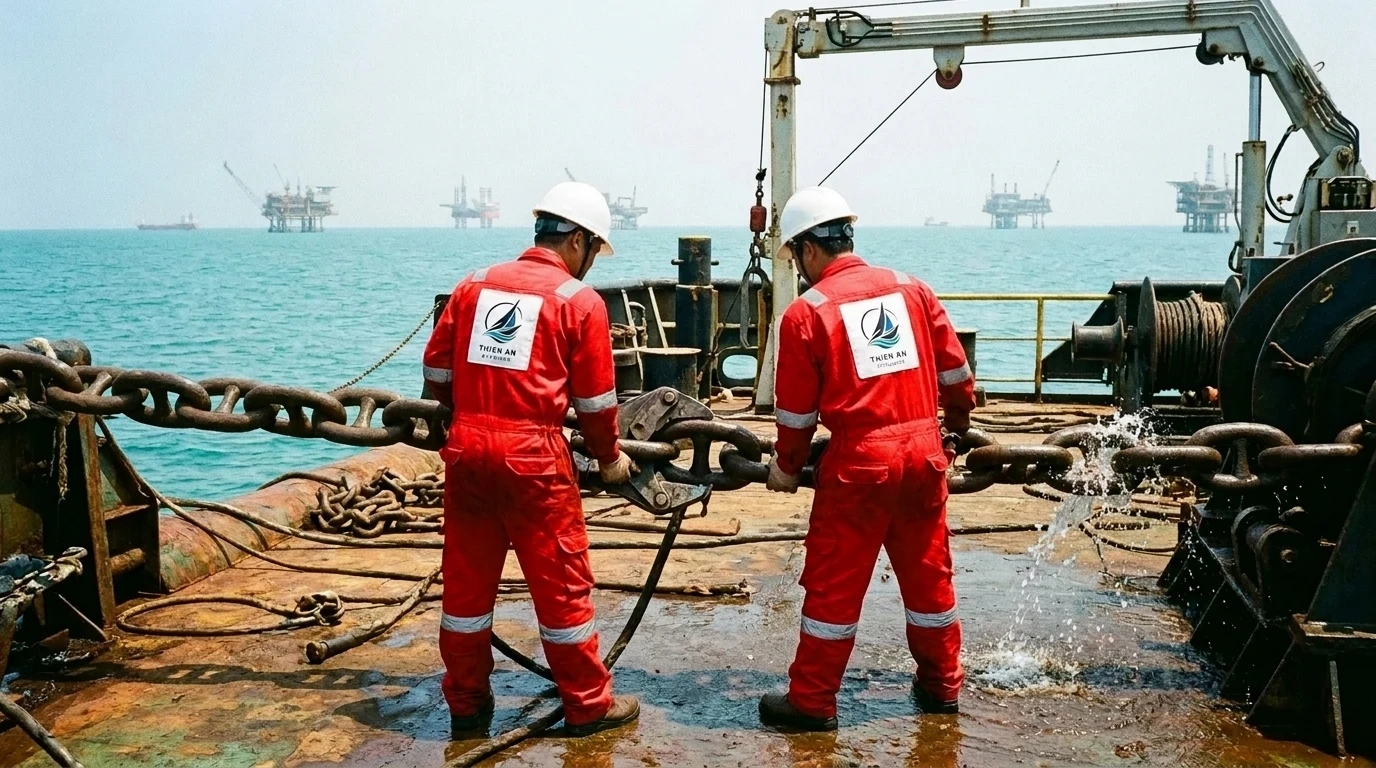
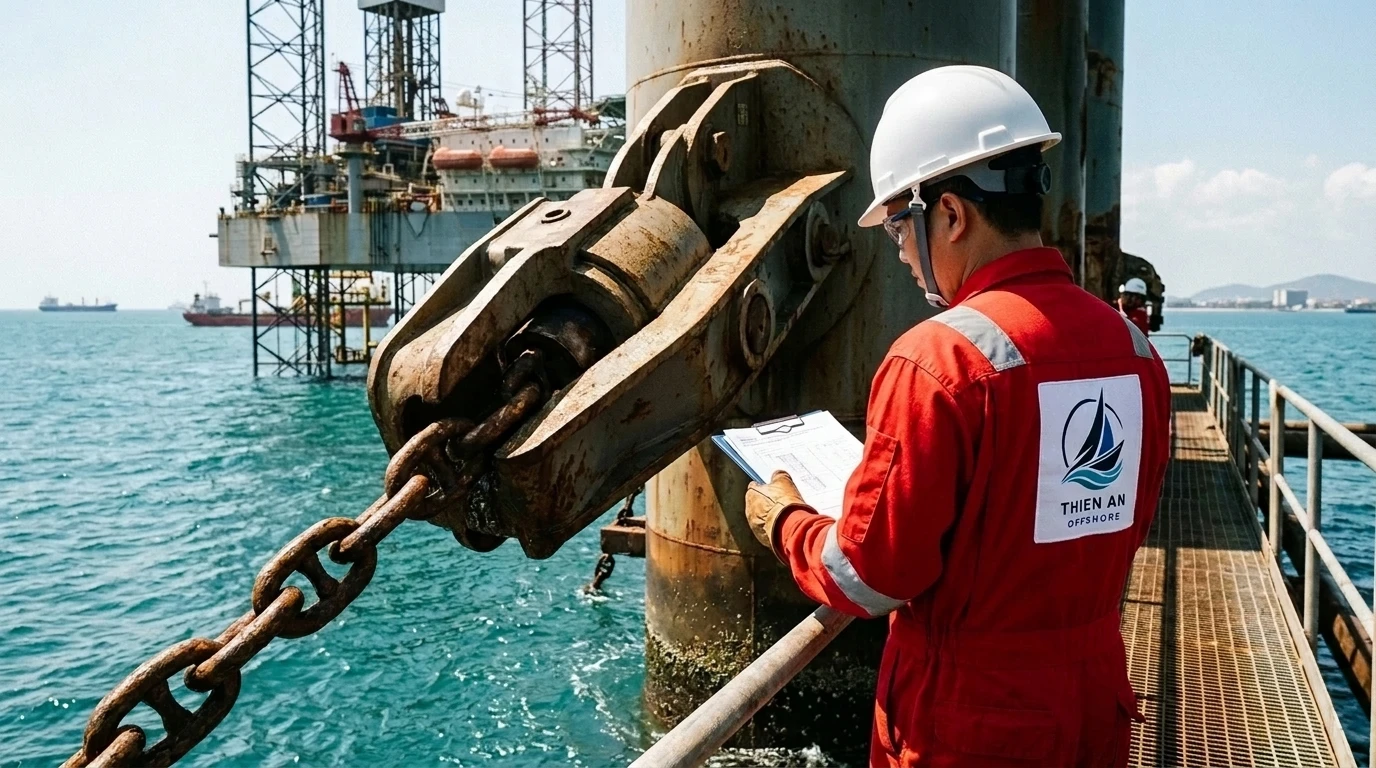
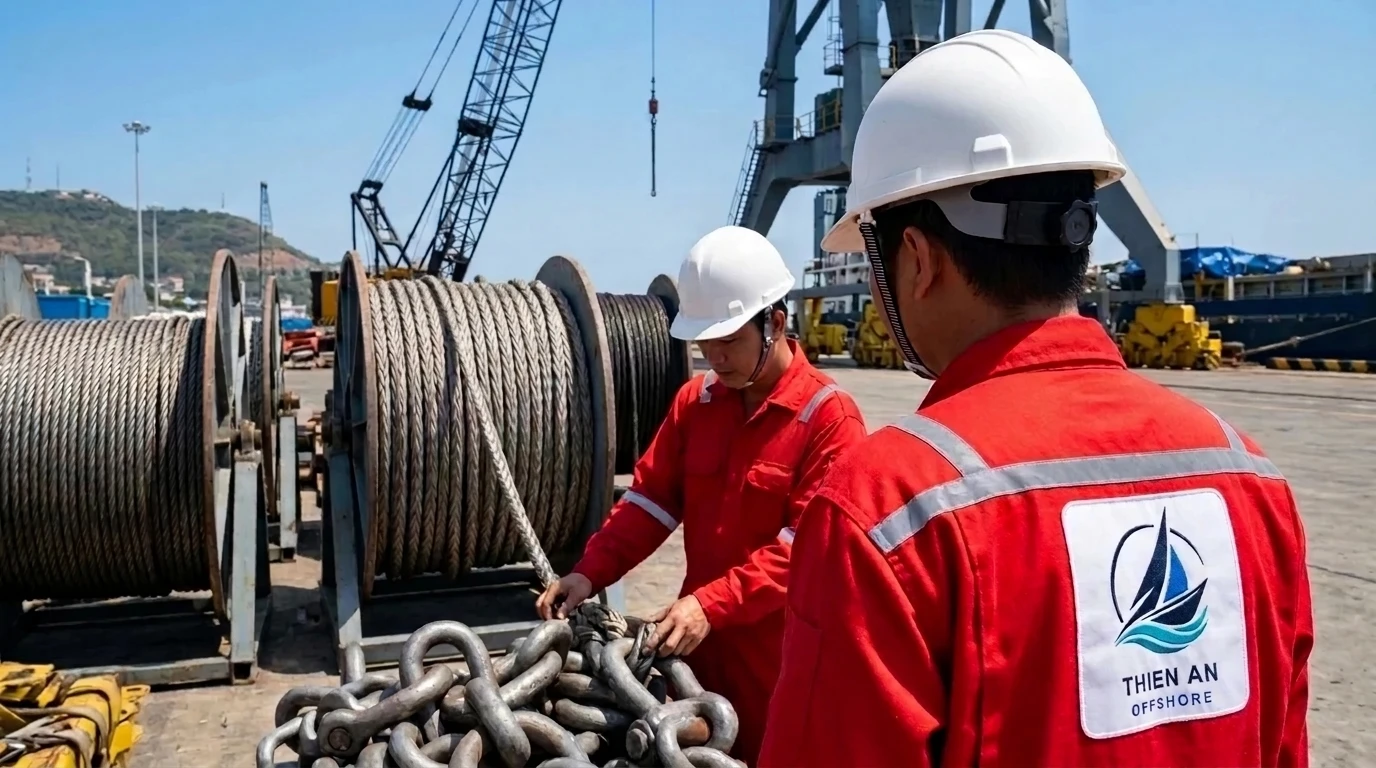
Field Operations: Mooring Deployment & Offshore Monitoring
| Configuration Type | Depth Range | Max Offset (% Depth) | Topside Vertical Load |
|---|---|---|---|
| Catenary Chain / Wire | < 300 m | 8 - 12 % | Very High (1,200 - 2,500 t) |
| Semi-Taut System | 200 - 800 m | 6 - 9 % | Moderate (600 - 1,100 t) |
| Taut-Leg Polyester | 400 - 2,000+ m | 3 - 6 % | Low to Moderate (350 - 750 t) |
| Internal Turret System | 150 - 1,500 m | 4 - 7 % | Concentrated (800 - 1,800 t) |
“In complex hydrodynamic environments such as the Vietnamese continental shelf, integrating non-linear wave simulation with real-time mooring line tension monitoring is paramount to floating facility integrity.”
Expert Engineering for Offshore Station Keeping
Thien An provides comprehensive engineering design, dynamic mooring analysis, anchor handling tug supply (AHTS) deployment, and subsea inspection services across all offshore basins.
Comments & Discussion0
Sign in to comment quickly without entering your name and email each time.
Sign in with Google